

Aviator is a crash game by Spribe in which an increasing curve can stop at any time. The player chooses a stake before take-off and can cash out while the multiplier rises, but the cash-out request must reach the server before the crash.
The commonly cited starting point is about $0.10 per bet. That figure is a baseline rather than a universal rule: the minimum stake, maximum stake, and possible win cap depend on the operator offering Aviator.
Aviator’s $0.10 baseline
Aviator commonly accepts stakes from about $0.10 per bet. The typical stake range extends up to about $100 per bet, but both ends depend on the operator.
The $0.10 figure helps explain the entry level across markets, but it does not mean every betting site uses dollars or the same amount. A bookmaker may display the minimum in a local currency, and the local value can be higher or lower when converted to dollars.
- The baseline reference is about $0.10 per bet.
- The typical upper reference is about $100 per bet.
- The displayed currency depends on the operator and market.
- The exact minimum appears in the Aviator betting panel before the round.
A minimum stake applies to one bet, not to a full session. Aviator has two bet panels per round, so a player can place one bet or use both panels where the operator allows it. Each panel can have its own cash-out setting.
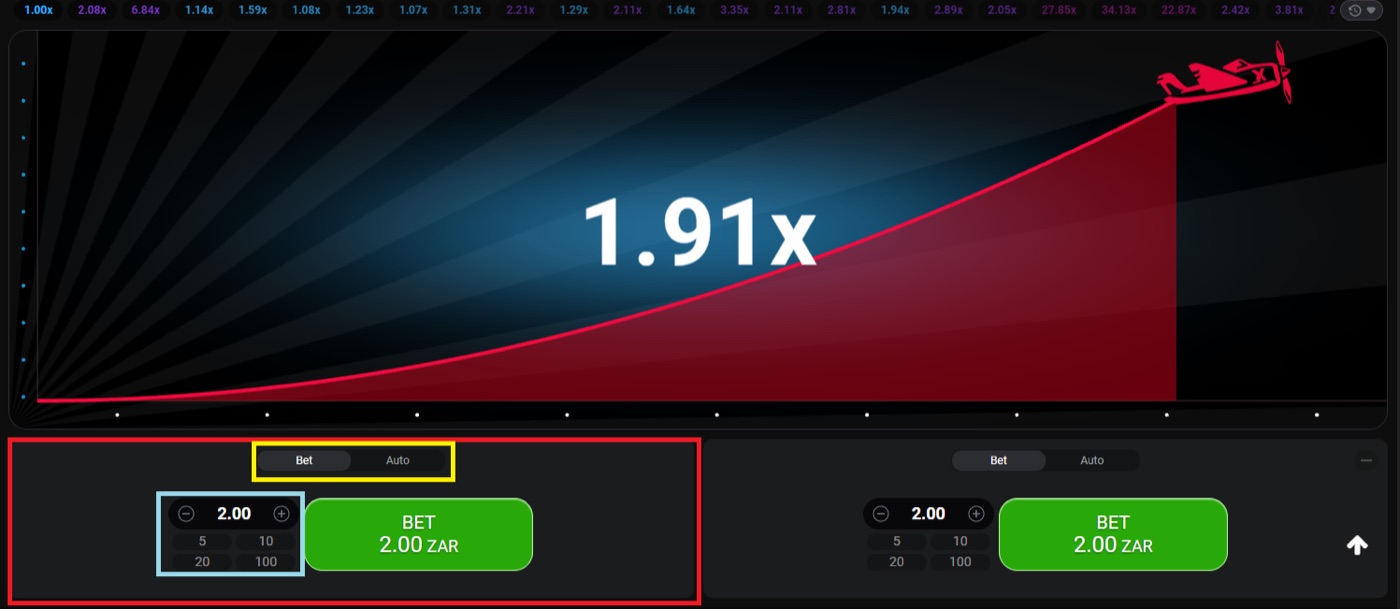
Aviator’s desktop round shows a 1.91x multiplier and two bet panels.
The stake does not change the mathematical edge. Aviator has a 97% RTP and a 3% house edge, so the expected value is negative 3% of the stake at every cash-out target. A larger stake increases the amount exposed in that round, while a smaller stake reduces the amount exposed.
Why operators set different minimums
Operator minimums differ because each operator sets its own stake limits. Aviator’s maximum win caps also come from the operator rather than from one published Spribe-wide figure.
The game runs inside an operator’s website or app, so the betting panel controls the available stake range. Spribe provides the game, while the operator presents it in a market-specific interface with its own limits and currency display.
- An operator chooses the minimum stake.
- An operator chooses the maximum stake.
- An operator sets the win cap for a round or bet.
- The operator places Aviator in its casino, instant-game, or crash-game menu.
This arrangement explains why two players can see different minimums while using the same Aviator game. The difference does not require a different crash mechanic. It can result from the operator’s configuration, the local currency, or the limits shown for that account and market.
Spribe does not publish one universal maximum multiplier. Guides quote different figures, while the operator sets win caps per round. Therefore, a minimum-stake comparison should not be treated as a complete comparison of possible returns.
Free bets and promotional credits can also be handled by operators individually, in batches, or through an API. Those offers do not establish the cash stake minimum, and their conditions depend on the operator.
For any gambling session, set a loss limit before staking and stop when that limit is reached.
How the stake works
Aviator uses two bet panels per round. Each panel supports a separate stake and a separate cash-out decision.
The round begins with a multiplier that rises from take-off. The player can cash out before the crash, while the stake is lost if the crash arrives first and the cash-out request has not reached the server.
- Choose a stake in one or both bet panels.
- Press Bet before the round starts.
- Watch the multiplier rise after take-off.
- Cash out manually or use Auto Cash-Out at a preset multiplier.
- Check the result after the round ends.
The Bet and Auto tabs provide different ways to enter a wager. Auto Cash-Out places the cash-out instruction at a selected multiplier, while Auto Bet or Auto Play can run for 10 to 100 rounds with stop-on-win and stop-on-loss settings.
Two panels can separate decisions within one round. For example, one bet may use a lower preset cash-out and the second may remain active for a higher target. The split changes how results are distributed, but it does not remove the 3% house edge.
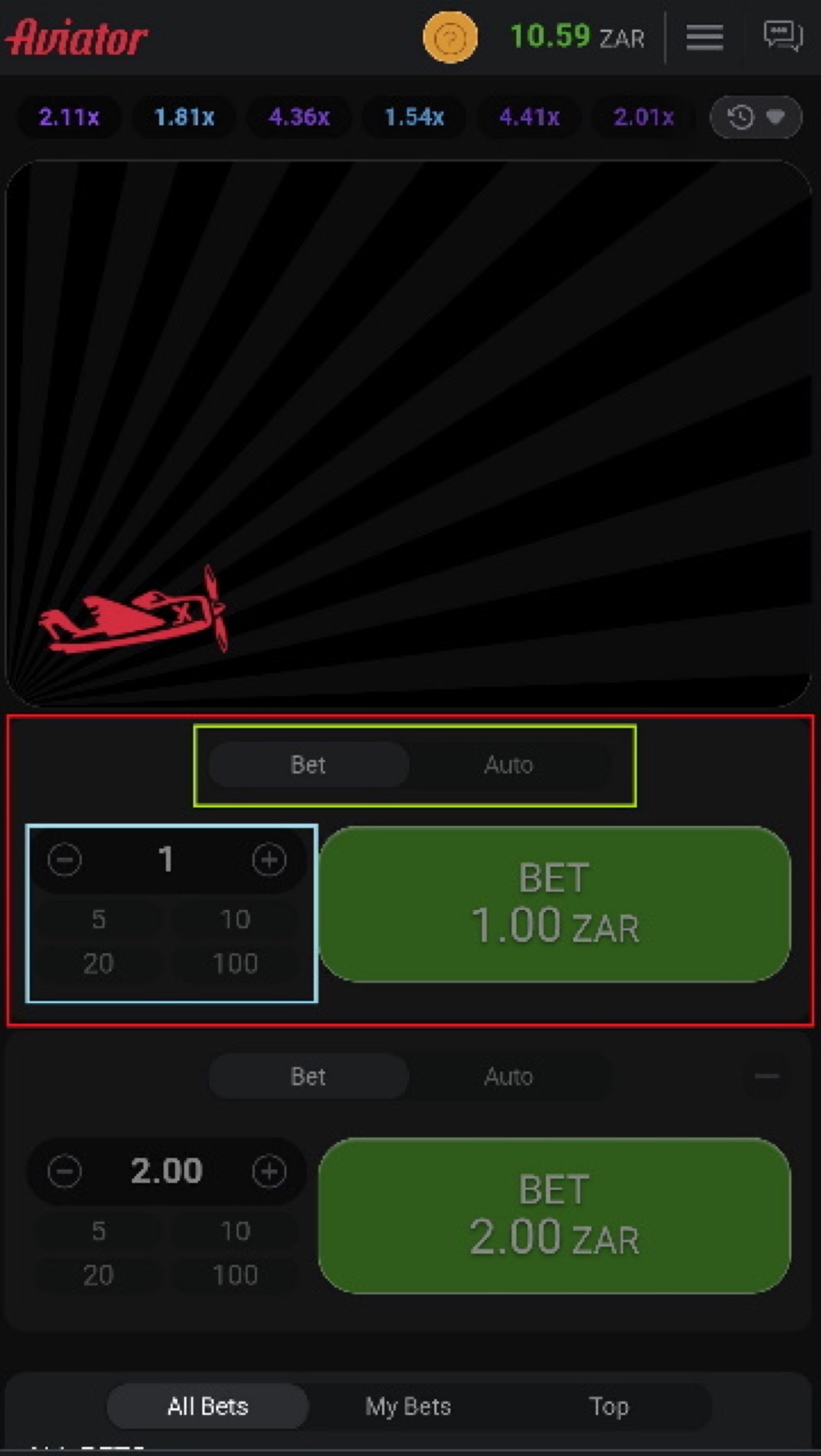
The mobile view presents Aviator’s betting and cash-out controls on a smaller screen.
- Manual cash-out depends on the player’s action and connection.
- Auto Cash-Out uses a preset multiplier.
- Auto Bet or Auto Play can cover 10 to 100 rounds.
- Stop-on-win and stop-on-loss can end an automated sequence.
Aviator rounds last about 8 to 30 seconds, with about 60 to 90 rounds per hour and a few seconds between rounds. A low minimum can make each individual decision smaller, but the number of rounds can still increase total exposure if a player continues without a limit.
The game’s outcomes are independent. Patterns, graph analysis, a best time to play, and a strategy chart do not change the odds or the minimum stake.
Minimums across markets
Betika Kenya lists a minimum Aviator stake of KES 10. SportPesa Kenya lists stakes from Ksh 2 to Ksh 50,000.
betPawa Nigeria lists a minimum of ₦1, while 1xBet lists stakes of 0.1 to 100. These examples show why the $0.10 baseline cannot be copied directly into every market.
| Operator example | Published minimum | Published stake detail |
|---|---|---|
| Betika Kenya | KES 10 | Aviator appears in the top menu |
| SportPesa Kenya | Ksh 2 | Stake range reaches Ksh 50,000 |
| betPawa Nigeria | ₦1 | Maximum win listed as ₦340,000,000 |
| 1xBet | 0.1 | Listed stake range is 0.1-100 |
| Betway South Africa | R1 | Maximum win listed as $250,000 per round |
| LottoStar South Africa | R1 | Maximum payout listed as R50 million |
The table gives operator examples rather than a fixed market rule. Minimums can change by operator, and the examples use different currencies, so a direct numerical ranking would be misleading without a currency conversion.
In Kenya, M-PESA paybill numbers are used by operators for deposits. In Nigeria, payment examples include OPay, PalmPay, MTN MoMo, Airtel SmartCash, bank transfer, and USDC at betPawa, but the payment method does not determine the Aviator minimum.
In a crash game, the stake is separate from the multiplier and cash-out instruction, so players comparing a bookmaker’s Aviator offer should check all three. For a broader gambling reference, some readers may also search for the aviator game kenya while comparing stake displays and cash-out rules.
- Kenyan examples use KES or Ksh values.
- Nigerian examples use naira values.
- South African examples use rand values.
- 1xBet publishes a numeric range of 0.1 to 100.
- The operator’s own betting panel remains the final check.
Checking the live minimum
The betting panel shows the available Aviator stake before a round begins. The displayed minimum is the practical limit for that operator, account, currency, and interface.
The game works on desktop, tablet, and mobile browsers. Spribe built it for low bandwidth and budget devices, but a slow connection can still affect a cash-out request.
- Open Aviator inside the operator’s website or app.
- Select the stake field in the first bet panel.
- Enter the smallest permitted amount or use a quick-stake button.
- Check whether the value is accepted before pressing Bet.
- Repeat the check in the second panel if using two bets.
Typical quick-stake buttons can make a value easy to select, but they do not prove that the button is the minimum. The editable stake field or the rejection message gives the more direct indication.
Some operators place Aviator under Casino, Instant Games, or a crash section. 1xBet lists it in the Casino or crash section as game ID 52358, while BetKing Nigeria places it under Menu, Casino, and Aviator.
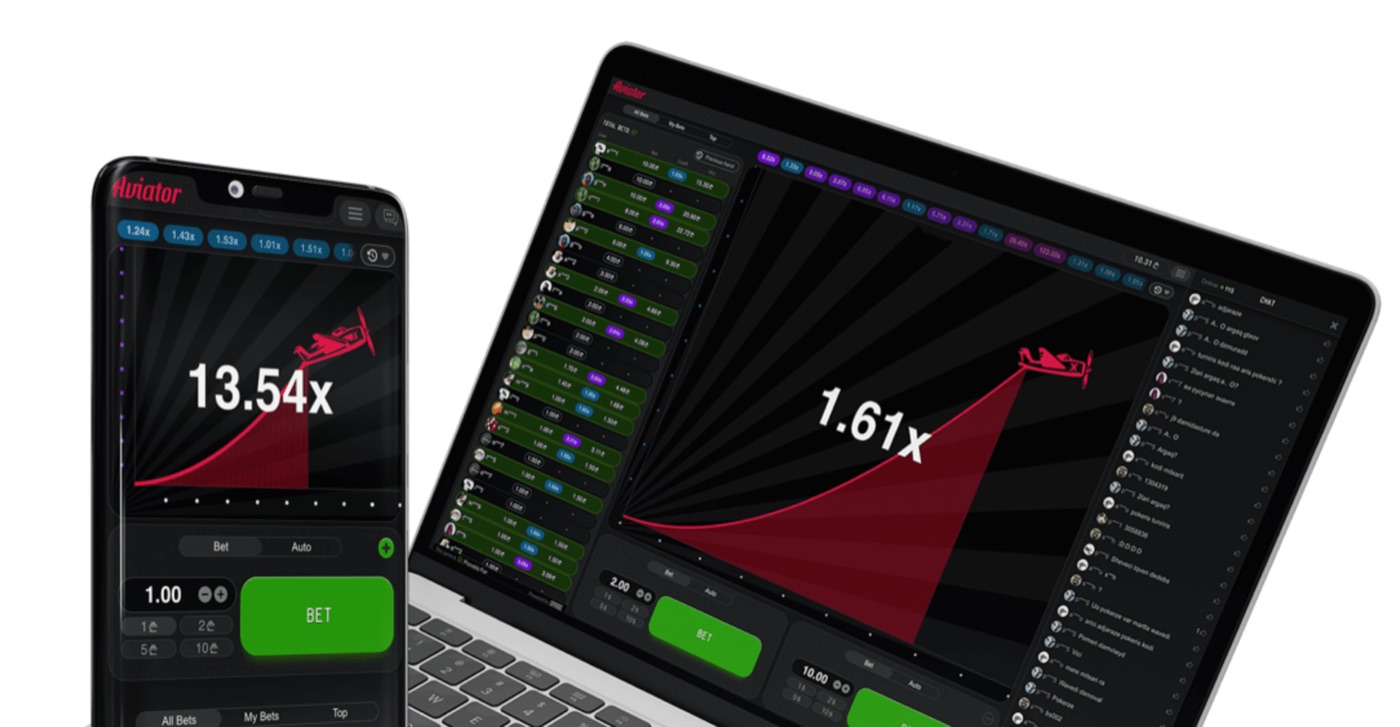
Aviator appears on a phone and laptop with multipliers of 13.54x and 1.61x.
There is no standalone official Aviator app from Spribe. The game runs inside a licensed operator’s website or app, while apps using names such as Aviator or Aviator Predictor are third-party clones and may state that virtual coins have no real value.
A demo mode is available through an operator demo or demo.spribe.io and needs no registration. Demo play can show the interface and stake controls, but it does not establish the minimum at a specific operator.
Minimums and possible returns
Aviator has a 97% RTP and a 3% house edge. The probability that a round reaches multiplier m is 0.97 divided by m.
At 1.2x, the stated probability is 80.8%; at 1.5x it is 64.7%; and at 2x it is 48.5%. At 5x it is 19.4%, while 10x is 9.7%.
| Target multiplier | Probability of reaching it | Gross return on a $0.10 stake |
|---|---|---|
| 1.2x | 80.8% | $0.12 |
| 1.5x | 64.7% | $0.15 |
| 2x | 48.5% | $0.20 |
| 5x | 19.4% | $0.50 |
| 10x | 9.7% | $1.00 |
The gross-return examples multiply the stake by the cash-out multiplier. They do not mean that a player will receive that amount on every round, because the listed probability applies to the round reaching the target.
About 3% of rounds, or roughly 1 in 33, crash instantly at 1.00x. A player who stakes $0.10 therefore risks $0.10 on that bet, while a player using the typical upper reference of $100 risks $100 on that bet.
- 1.2x corresponds to 80.8% in the stated probability table.
- 1.5x corresponds to 64.7%.
- 2x corresponds to 48.5%.
- 5x corresponds to 19.4%.
- 10x corresponds to 9.7%.
Changing the stake changes the dollar amount of wins and losses, not the probability table. Changing the cash-out target changes variance, not the 3% edge.
Minimum-stake decisions
Aviator’s expected value is negative 3% of the stake at every cash-out target. A stake plan should therefore control exposure rather than assume that a lower minimum creates a profitable strategy.
Guides commonly suggest risking no more than 2% of a bankroll per round. They also suggest setting loss and win limits before play, starting in demo mode, and treating the minimum as a way to keep one decision smaller.
- Confirm the operator’s minimum in the stake field.
- Choose a fixed amount that fits the session limit.
- Avoid raising the stake to recover a loss.
- Set a stop-on-loss or personal loss limit.
- Stop when the limit or planned session ends.
Martingale doubles the stake after each loss and reaches 1,024 times the base stake after 10 losses. Fibonacci and D’Alembert systems also do not beat the 3% edge.
Two-bet play can divide a round between a lower cash-out and a higher target. The arrangement may change the pattern of results, but it does not change the expected value or make the minimum stake disappear.
Provably fair tools allow the result to be checked. Before each round, the server publishes a SHA-256 hash of the server seed, player client seeds are combined with it, and the crash point is fixed before take-off. The inputs become visible after the round and can be checked with the tool inside the game.
Neither the operator nor Spribe can change a result after the round starts. A cash-out time-out can instead occur when the request reaches the server after the crash, often because of latency or a slow device.
Aviator FAQ
Is $0.10 the fixed minimum?
No. About $0.10 is the common baseline, while the exact minimum depends on the operator, market, currency, and betting interface.
Which operator sets the Aviator minimum?
The operator offering Aviator sets the minimum stake, maximum stake, and win caps. Spribe provides the game, but there is no single universal operator limit.
Can two panels use different stakes?
Yes. Aviator has two bet panels per round, and each panel can have its own stake and cash-out decision where the operator enables both.
Does a smaller stake improve the odds?
No. Aviator’s RTP is 97% and its house edge is 3%. A smaller stake reduces the amount at risk, but it does not change the probability of reaching a multiplier.
Where can the live minimum be checked?
Open Aviator inside the operator’s website or app and inspect the stake field before betting. The accepted smallest value is the practical minimum for that interface.
Is there an official Aviator predictor app?
No standalone official Aviator app from Spribe exists. Prediction is impossible because the crash point is committed by hash before the round, and third-party predictor apps or signal bots do not change that result.